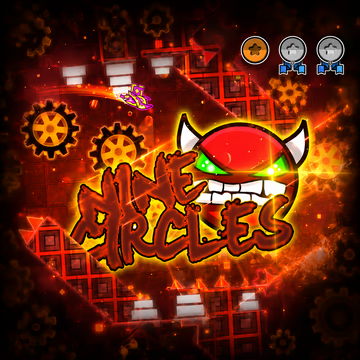
What Is Geometry Dash Nine Circles?
Geometry Dash Nine Circles is a platformer that tests your reflexes, observation skills, and precision with every move. Inspired by the famous Nine Circles style in the Geometry Dash community, this game takes you through dense geometric corridors where one mistimed input can send your character crashing into an obstacle.
Gameplay
In Geometry Dash Nine Circles, your main goal is to guide your character through obstacles and reach the end of the level without crashing. The paths feature tight spaces, sharp spikes, and geometric structures that demand your full attention as you move forward.
As you play, you'll experience different movement mechanics as your character switches between modes. The Wave sections are especially challenging, requiring precise presses and releases to create a trajectory that fits through the corridors ahead.
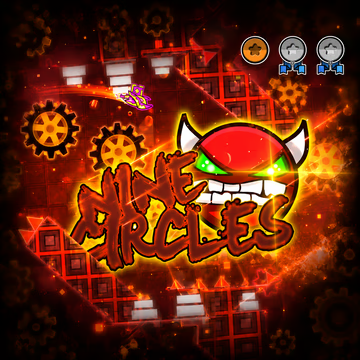
Figure 1. Geometry Dash Nine Circles challenges with intense Wave sections
Controls
The game's simple control scheme lets you focus on watching the path and avoiding obstacles.
- Left Mouse Button: Click to control the character.
- Z: Press Z to place a checkpoint.
- X: Press X to delete a checkpoint.
Key Features of Geometry Dash Nine Circles
Wave Gameplay Requires High Precision
Wave is a key element that defines the Nine Circles style. When you hold the control button, your character moves diagonally in one direction. Releasing the button reverses its direction. Alternating between these two actions creates a zigzag path, allowing you to navigate narrow corridors and avoid obstacles along the way.
The mechanic may look easy to pick up, but mastering it takes serious practice. Holding the button for too long can send your character into the ceiling, while releasing it at the wrong moment can lead straight into danger. You need to watch the space ahead and adjust your timing to match each section of the path.
Distinctive Lighting and Geometric Effects
This version stands out with sharp geometric shapes, contrasting colors, and flashing light effects. These elements create a striking visual atmosphere while highlighting transitions between different sections of the level.
The visual effects often become more intense as the music builds toward its climax. The combination of movement, colors, and obstacles makes each run feel fast-paced, challenging you to stay focused even when the screen fills with visual details.
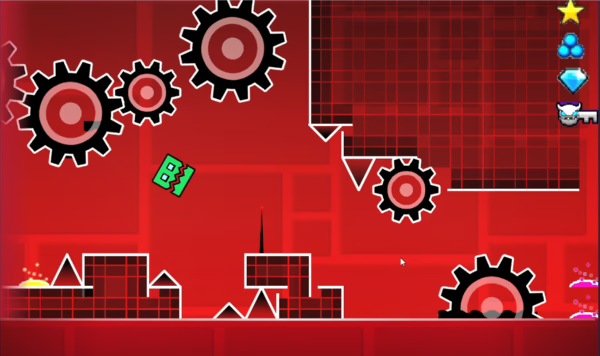
Figure 2. Distinctive Lighting and Geometric Effects
Multiple Movement Modes in One Level
Switching between movement modes adds variety to the gameplay. Depending on the version's design, you may encounter the Cube, which jumps over spikes; the Ship, which requires you to control your flight height; the Ball, which lets you change gravity; and the Wave, which follows its signature zigzag path.
Each mode requires a different approach. The Cube focuses on jump timing, the Ship demands control over altitude, the Ball requires you to watch for gravity changes, and the Wave relies on precise presses and releases. When switching between modes, you need to adapt quickly instead of relying on the same control strategy for every situation.
Level Structure and Difficulty in Geometry Dash Nine Circles
The difficulty of Geometry Dash Nine Circles comes from the placement of obstacles and the constant changes in movement throughout the level.
Geometry Dash Nine Circles Level Structure and Difficulty
Geometry Dash Nine Circles is divided into several sections featuring different movement modes and challenges. The Wave sections are the main highlight, especially the narrow corridors, gravity changes, and precise inputs required to avoid obstacles.
| Progress |
Mode |
Features and Difficulty |
| 0–22% |
Cube, Ship |
Starts with jumps before switching to the Ship, which requires precise altitude control through narrow corridors filled with dangerous saws. |
| 22–34% |
Ball |
Requires well-timed orb interactions and gravity changes, along with careful attention to tricky obstacles. |
| 34–39% |
Cube |
A short transition with several jumps that prepares players for the more challenging Wave sections. |
| 39–50% |
Wave |
Introduces challenging Wave gameplay with narrow corridors that demand precise timing and trajectory control. |
| 50–62% |
Wave |
Increases the difficulty with gravity changes, faster movement, and a Dual Wave section that requires accurate inputs. |
| 62–72% |
Mini Wave |
Narrower paths demand quick reflexes to avoid hitting walls and obstacles. |
| 72–83% |
Mini Wave |
One of the most difficult sections, combining smaller character size, reversed gravity, and demanding path memorization. |
| 84–100% |
Cube |
The final section requires well-timed jumps and orb interactions to clear the remaining obstacles. |
If Geometry Dash Nine Circles gets you hooked on precise timing and overcoming consecutive obstacles, Geometry Dash Lite is another great option for exploring the platforming gameplay that defines the series. The Lite version features fast-paced levels, well-timed jumps, and challenges that gradually increase as you progress.
While Nine Circles stands out for its Wave sections and distinctive visual effects, Geometry Dash Lite offers a variety of challenges to help you sharpen your reflexes. Both experiences take different approaches, but they encourage you to learn from every failure and keep improving your skills.
Start with Geometry Dash Nine Circles, master each tricky section, and push your reflexes to the limit. When you're ready for a new adventure, Geometry Dash Lite offers more opportunities to overcome obstacles with focus and precise timing.