What Inspired the Idea Behind Geometry Dash Polargeist?
Geometry Dash Polargeist takes players on an obstacle course where every jump requires focus and precise timing. As the third official level in Geometry Dash, Polargeist builds on the experience of Stereo Madness and Back On Track while introducing new mechanics for players to explore.
The core idea is to use familiar geometric elements to create challenges that gradually increase in difficulty. A cube automatically moves forward, but the path ahead is far from smooth. Spikes, gaps, and platforms appear one after another, forcing players to stay alert and react at the right moment.
Why Can a Simple Level Still Be Challenging?
Polargeist features minimalist geometric visuals and straightforward controls, but that doesn't mean the level is easy to complete. The character keeps moving forward, so players must make quick decisions instead of stopping to examine every obstacle.
Polargeist also combines different movement styles, including Cube Mode and Ship Mode. Switching from jumping over obstacles to controlling a ship's height changes how players need to react. Rather than relying on a single action for every situation, players must adapt to each section of the level.
Figure 1. Geometry Dash Polargeist brings challenging jumps
How Geometry Dash Polargeist Turns Jumps Into Challenges
In Polargeist, a successful jump depends on both timing and positioning. Jumping too early may cause the character to land before clearing an obstacle, while jumping too late can lead to a collision with spikes. That's why watching the path ahead is an essential skill throughout the level.
Yellow Jump Rings add another layer of challenge to the jumping mechanics. When the cube passes through a yellow jump ring, players can press the control button to trigger an extra jump. Timing the action correctly helps the character clear obstacles and land safely. Repeatedly pressing the button out of habit can cause players to miss the opportunity to use the ring effectively.
Ship Mode introduces a different approach to movement. Holding the button makes the ship rise, while releasing it allows the ship to descend. Instead of timing individual jumps, players must constantly adjust their height to navigate through tight spaces.
How to Play Geometry Dash Polargeist
The main objective is to guide the character through every obstacle and reach the end of the level. Along the way, players can also collect three Secret Coins hidden in locations that require careful observation and precise movements.
Controls
The game uses controls similar to those in the familiar Geometry Dash Extrapolation. The character automatically moves forward, so players mainly focus on jumping and adjusting movement when necessary.
- Desktop: Click the left mouse button, press Space, or use the Up Arrow to jump, depending on the version.
- Mobile: Tap the screen to control the character.
Tips for Beginners
- Watch the obstacles ahead: Don't focus only on the cube's current position. Keep an eye on the next platform so you can prepare your next move.
- Time your jumps: Avoid jumping too early or too late. Learn the right timing with each attempt.
- Practice using Jump Rings: Watch the ring's position and activate it as the cube passes through to trigger an extra jump.
- Focus on completing the level first: Learn the main route before trying to collect all three Secret Coins. If Practice Mode is available, use checkpoints to train on difficult sections.
Music, Colors, and Movement in Polargeist
Music Sets the Pace
The soundtrack plays an important role in the Polargeist experience. Its rhythm helps the level feel cohesive and gives players another cue as they become familiar with the movement patterns. With repeated attempts, combining what they hear with what they see can help players remember familiar sections of the course.
Colors Highlight Obstacles
The geometric art style uses contrasting colors to distinguish the character, platforms, and obstacles. This visual approach helps players recognize important elements along the path without being distracted by too many decorative details. The yellow jump rings also stand out, drawing attention to opportunities for extra jumps.
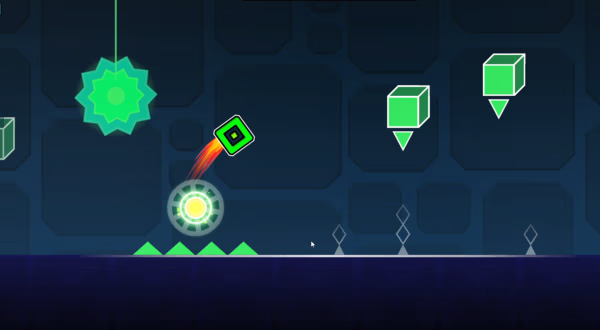
Figure 2. Colors Highlight Obstacles
Movement Keeps the Gameplay Flowing
The cube automatically moves forward, obstacles appear in quick succession, and changes in movement mechanics create Polargeist's distinctive pace. Motion effects help players follow their progress through the level while keeping their attention on the next action.
Three Secret Coins Add Extra Goals
Beyond reaching the finish line, players can challenge themselves to collect the three Secret Coins scattered throughout Polargeist. These collectibles add another objective to each run, especially for those who want to explore more than the main route.
The coins may appear in locations that require precise timing, height adjustments, or alternative approaches to the main path. Collecting them therefore calls for careful observation and better control of the character. An inaccurate jump can cause players to miss a coin or collide with an obstacle while trying to reach it.
For the best results, get familiar with the entire level first, then focus on one coin at a time. Once you remember the route and the timing of each action, combining a successful run with collecting the hidden items becomes more manageable.
Conquer Geometry Dash Polargeist
Geometry Dash Polargeist combines straightforward controls with challenges that demand precision. Its music, colors, and geometric movement create a level with a clear sense of pace.
Whether you're new to Geometry Dash or already experienced with obstacle courses, you can start by learning the route, practicing individual moves, and improving with each attempt. Jump into Polargeist, find your rhythm, and see if you can reach the finish line with all three Secret Coins.