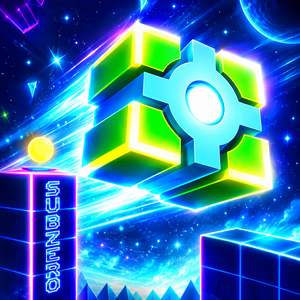
How 3D Perspective Changes the Gameplay in Geometry Dash Subzero 3D?
Geometry Dash Subzero 3D offers a fresh take on the familiar Geometry Dash formula by bringing the course and obstacles into a three-dimensional space. Instead of viewing geometric shapes on a flat surface, players need to pay attention to depth, distance, and changing perspectives as the character moves forward.
The 3D perspective directly affects how players judge when to jump. A spike may appear far away at first, but the distance quickly closes as the character moves forward. Simply looking at the shape of an obstacle isn't enough. You need to watch its position on the track and prepare to react at the right moment.
The three dimensional environment also requires better spatial awareness. With geometric shapes, platforms, and movement effects appearing together, focusing on the path ahead helps you spot danger earlier. This is what sets Geometry Dash Subzero 3D apart: overcoming each obstacle requires a combination of observation, timing, and quick reflexes.
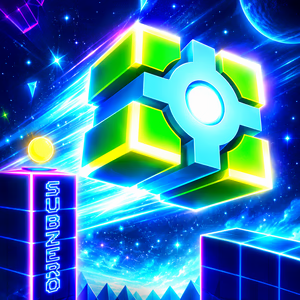
Figure 1. The icy world of Geometry Dash Subzero 3D
How to Play Geometry Dash Subzero 3D
Main Objective
The goal of Geometry Dash Subzero 3D is to guide your character past obstacles and travel as far as possible along the course. As you move forward, you must avoid spikes, dangerous gaps, and other obstacles in your path.
Controls
Geometry Dash Subzero 3D features simple controls that let you focus on the track and the obstacles ahead.
- Left Mouse Button: Click to perform an action while playing on a computer, depending on the version's control scheme.
- Touchscreen: Tap the screen to control the game on supported mobile devices.
Geometry Dash Subzero 3D Strategies for Beginners
If you're just getting started, take some time to get familiar with the movement speed and how obstacles appear before tackling the more difficult sections.
Look Ahead Instead of Focusing Only on Your Character
In a 3D environment, perspective can make obstacles look different depending on their position. Keep an eye on the track ahead so you can prepare for your next move.
Time Your Jumps Carefully
As you approach spikes or gaps, pay attention to your character's position and choose the right moment to jump. Jumping too early or too late can end your run.
Remember Where You Keep Failing
If you repeatedly crash at the same section, figure out what went wrong instead of repeating the same move. You might be jumping too early, misjudging the distance, or overlooking the next obstacle.
Maintain a Steady Rhythm
When you encounter a series of obstacles, stay focused and handle each situation one at a time. Rushing to react to every obstacle can cause you to miss the right timing.
Be Patient With Every Attempt
Each failed run can help you better understand the course layout. By remembering dangerous spots and adjusting your timing, you'll have a better chance of making it farther on your next attempt.
Inside the Icy Visual World of Geometry Dash Subzero 3D
The visual style is an important part of Geometry Dash Subzero 3D's identity. Cool colors evoke an icy atmosphere, while geometric shapes and lighting effects give the course a modern look.
Shades of blue and white, along with bright highlights, can create contrast between the environment and the obstacles. This gives players visual cues to help identify objects as they move forward. The combination of distinct shapes and continuous movement also keeps the game world feeling lively.
The three dimensional perspective adds depth to the environment. The course is no longer just a series of shapes on a flat surface. Instead, it becomes a space where players must observe and react. As the character moves forward, changes in perspective create a stronger sense of motion.
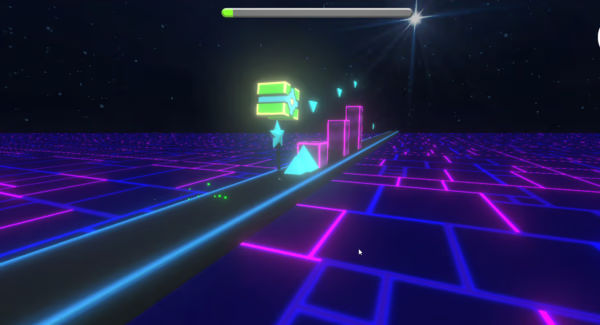
Figure 2. Inside the Icy Visual World
2D vs. 3D Geometry Dash: Which Feels More Challenging?
The 2D Version
In the 2D version, also known as Geometry Dash SubZero, the course appears on a flat plane with a relatively straightforward obstacle layout. Players typically focus on horizontal distance, obstacle height, and the right moment to jump.
This presentation makes it easier to see the relationship between the character and nearby obstacles. After a few attempts, remembering movement patterns can help players improve. However, high-speed sections and complex layouts still require precise reflexes and strong memory.
The 3D Version
In Geometry Dash Subzero 3D, perspective adds a sense of depth to the course. Players need to pay attention not only to an obstacle's position but also to how its apparent distance changes as the character moves forward.
This can make timing more challenging for players who are used to a 2D perspective. On the other hand, the three-dimensional environment offers a different visual experience and makes observing the course more engaging.
It's not accurate to say that 3D is always harder than 2D. The actual difficulty depends on the speed, obstacle placement, and design of each level. Players familiar with the classic style may need time to adjust, while those who enjoy three-dimensional perspectives may find this approach more appealing.
Conclusion
Geometry Dash Subzero 3D combines familiar obstacle dodging gameplay with a three-dimensional perspective and an icy visual style. The change in perspective encourages players to pay closer attention to distance, jump timing, and obstacle positions.
For beginners, the best approach is to watch the track ahead, practice difficult sections, and learn from each failed attempt. If you're looking for a different spatial experience in the Geometry Dash universe, give Geometry Dash Subzero 3D a try and find the strategy that works best for you.