Where Did the Idea for Geometry Dash 3D Begin?
The Origin of the Idea
Geometry Dash 3D began with the idea of bringing the familiar obstacle-jumping experience of Geometry Dash into a world with greater depth. The original version stands out for its simple controls, dangerous spikes, and the precise timing required to jump over obstacles. However, moving into a three-dimensional environment offers a different sense of distance, perspective, and movement with every challenge.
The idea behind Geometry Dash 3D focuses on preserving that core spirit while presenting it in a new way. The geometric cube continues moving forward, while players must watch the path and react to incoming obstacles. The three-dimensional environment adds depth to each level, making spatial awareness and precise timing important parts of the experience.
The Story Behind the Idea
Imagine rushing to an important appointment on a busy morning. The destination isn't far away, but unexpected situations keep appearing along the way: a pedestrian crosses the street, the car ahead slows down, and the traffic light changes just as you're about to pass through. One moment of inattention can force you to stop and adjust your plans.
In everyday life, the challenge isn't always about moving faster. Sometimes, it's about recognizing what's coming and choosing the right moment to act. The same idea can be found in this 3D version. The cube keeps moving forward, while players must watch the path, anticipate obstacles, and react at the right moment.
Figure 1. Geometry Dash 3D offers a fresh way
Geometry Dash 3D Gameplay
Geometry Dash 3D combines automatic movement with obstacle-jumping challenges in a three-dimensional environment. The cube moves forward along the course, and your job is to time each jump to avoid spikes, clear gaps, and keep moving toward the finish line.
One of the most noticeable aspects is how perspective changes the way you see the course. Obstacles in the distance gradually approach, giving you time to observe and prepare. However, the added perspective also makes judging distances more challenging than in a familiar flat, two-dimensional view.
The gameplay revolves around observing, reacting, and learning from each attempt. Once you memorize the obstacle layouts, you can make more informed decisions about when to jump. This creates a continuous challenge where focus and precision matter more than simply making repeated inputs.
How to Play Geometry Dash 3D
To get started, familiarize yourself with the cube's movement and pay attention to how obstacles appear along the course.
Controls
The controls are designed to be simple, allowing you to focus on avoiding obstacles.
- PC: Left-click to jump.
- Mobile: Tap the screen to jump.
Geometry Dash 3D Tips
- Look Ahead: Watch the obstacles approaching rather than focusing only on the cube. This helps you prepare for your next jump.
- Time Your Jumps: Don't jump as soon as you spot a spike. Pay attention to the distance and how long the cube takes to reach the obstacle.
- Learn From Failed Attempts: Remember where you collided with an obstacle and adjust your timing on the next run.
- Stay Consistent: Avoid rushing your inputs when facing several obstacles in a row. Staying focused helps you react more consistently.
What Makes Geometry Dash 3D Different?
How Camera Perspective Changes the Gameplay
The camera perspective is one of the most noticeable differences in this game. Instead of viewing the character and obstacles on a flat plane, players see the course with depth and perspective. Objects appear to change size as they approach, making distance awareness part of the challenge.
This change also affects how players prepare for each jump. Spotting obstacles early, tracking their relative positions, and judging when to approach them can help you react more confidently. The 3D perspective therefore does more than change the game's appearance; it directly influences how you approach the gameplay.
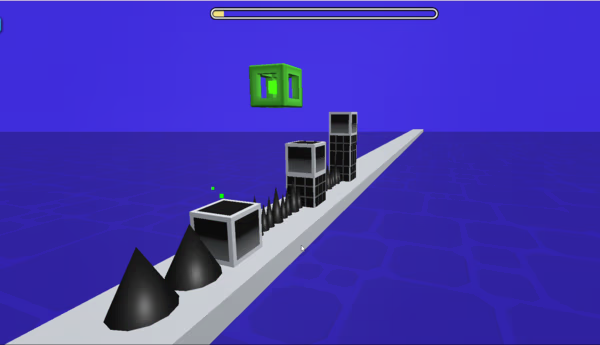
Figure 2. Camera Perspective Changes
Building the Visual Identity
The 3D version maintains the series' signature geometric style, featuring a cube character and clearly shaped obstacles. Within a three-dimensional environment, these shapes gain depth, making the course feel as if it extends forward rather than remaining entirely on a flat plane.
Visual design plays an important role in helping players follow the course. The contrast between the character, background, and obstacles helps distinguish different elements along the path. This keeps the experience focused on reflexes and overcoming challenges without distracting players with unnecessary details.
Checkpoints
Checkpoints can support practice by allowing players to resume from a marked position instead of restarting the entire level. This feature is especially useful when learning difficult sections or memorizing sequences of obstacles.
However, checkpoint availability depends on the specific game mode and version. When the feature is available, use it to practice individual sections, find the right jump timing, and improve your precision with each attempt.
Conclusion
One jump can change the entire run in Geometry Dash 3D. With obstacles approaching through a three-dimensional world, every moment becomes a chance to test your instincts, read the path ahead, and react before it's too late. Ready to see how far your timing can take you? Step into the 3D challenge, or switch things up with Geometry Dash Lite and rediscover the classic thrill of jumping through geometric obstacles in a familiar 2D world.