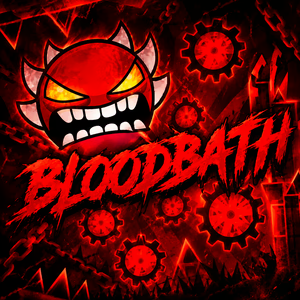
How Bloodbath Changed the Geometry Dash Community
Bloodbath helped establish a new benchmark for difficulty in Geometry Dash. Developed through a collaboration between multiple creators and organized and verified by Riot, the level brought together different design styles in one demanding experience. Its successful verification on August 12, 2015, marked a major moment in the community's history.
At the time, Bloodbath reached the top of the Demonlist, becoming a reference point for players interested in the hardest levels available. Its reputation encouraged more creators to experiment with complex gameplay, tighter passages, faster transitions, and elaborate visual effects. Extreme Demon levels became an increasingly important part of the community's creative culture.
Bloodbath also demonstrated how collaboration could produce a cohesive level despite differences in individual building styles. Each creator contributed a section, while the complete experience maintained a recognizable atmosphere and consistent challenge. This approach helped inspire future community projects and reinforced the value of shared creativity in Geometry Dash.
Although many harder levels have appeared since its release, Bloodbath remains a landmark. Its influence comes not only from its original difficulty ranking but also from the players who practiced, completed, and discussed it over the years.
Figure 1. Experience Geometry Dash Bloodbath
Styles Geometry Dash Bloodbath
Bloodbath combines aggressive visuals, rapid gameplay, and music-driven action to create a distinctive identity. Every element contributes to an atmosphere that makes the level feel dangerous from beginning to end.
Red and Black Hell Themed Visuals
The most recognizable feature of Bloodbath is its red and black aesthetic. Dark backgrounds contrast with bright red structures, sharp spikes, and threatening decorations. The hell-themed presentation gives the level an intense appearance without relying on a completely different visual style in every section.
The design also supports the gameplay. Dangerous obstacles stand out against darker backgrounds, while tightly packed structures reinforce the feeling that every movement requires precision. As the level progresses, the combination of colors and detailed decorations maintains a sense of pressure.
Bloodbath's visual identity became closely associated with the Extreme Demon style. Its dramatic appearance helped make gameplay recordings recognizable and gave the level a lasting presence throughout the Geometry Dash community.
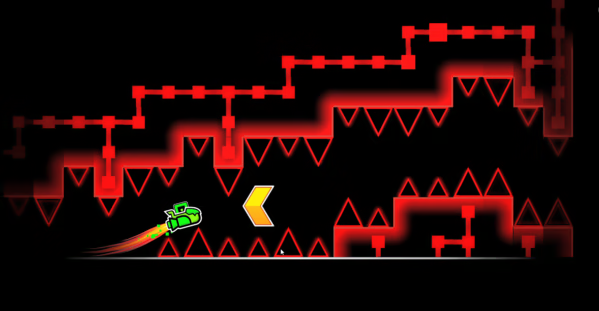
Figure 2. Red and Black
Music That Drives the Pace
Bloodbath uses At the Speed of Light by Dimrain47 as its soundtrack. The energetic electronic track complements the level's fast movement and demanding sequences, creating a strong connection between the audio and gameplay.
The music helps establish a rhythm that players can learn through repeated attempts. Recognizing musical patterns may make certain transitions easier to anticipate, although success still depends on precise timing and familiarity with the obstacles.
Rather than serving as background decoration, the soundtrack strengthens the intensity of the experience. Its combination with the red visuals and rapid gameplay is a major reason Bloodbath remains memorable.
Geometry Dash Bloodbath Gameplay
Bloodbath is a rhythm-based platforming challenge in which your icon moves automatically through a long sequence of obstacles. Your task is to survive every section by jumping, flying, and navigating narrow passages without hitting spikes or other hazards.
The level features multiple gameplay modes, including Cube, Ship, and Wave, alongside additional transformations. Each mode requires a different approach. Cube sections focus on accurately timed jumps, while Ship sequences demand careful control of vertical movement. Wave sections require precise changes in direction through tight corridors.
Portals introduce changes in movement mode, gravity, or speed, forcing you to adjust quickly. Some sections are especially unforgiving because a small mistake can end an otherwise successful attempt.
Bloodbath's difficulty comes from more than individual obstacles. Players must connect multiple demanding sections into one consistent run. Learning each part separately is useful, but completing the entire level requires concentration, reliable timing, and the ability to perform under pressure.
How to Play Geometry Dash Bloodbath
The objective is straightforward: guide your icon through the entire level without colliding with obstacles. The challenge lies in learning when to press, release, and adjust your movement as the gameplay changes.
Controls
The exact controls may vary slightly depending on the version you're playing.
- Left mouse button: Jump or activate the current movement action.
- Spacebar: Perform the same primary action in supported browser versions.
- Up arrow: Control movement in supported versions.
- Touchscreen: Tap and hold to control your icon on mobile devices.
Tips for Beginners
- Start with Practice Mode. Use checkpoints to learn difficult sections without restarting the entire level after every mistake. Focus on understanding obstacle placement and movement timing.
- Learn one section at a time. Divide the level into smaller segments and practice each until your movements become consistent. Gradually connect the sections to build longer successful runs.
- Pay attention to portals. Changes in movement mode and gravity can disrupt your timing. Learn what comes immediately after each portal so you can prepare for the next obstacle.
- Stay calm during difficult attempts. Reaching a high completion percentage can create pressure, but rushing often leads to mistakes. Focus on the next obstacle instead of worrying about the entire run.
- Practice Ship and Wave control. These modes demand precise movement, especially in narrow corridors. Short, controlled inputs are often more effective than holding the button for too long.
The Hardest Parts of Geometry Dash Bloodbath Explained
Bloodbath is difficult because several demanding mechanics appear throughout the level, leaving little room for inconsistent inputs.
Ship sections are particularly challenging when the available flying space becomes narrow. You must maintain a stable path while avoiding spikes above and below. Overcorrecting can be just as dangerous as failing to react quickly enough.
Wave sections create another major challenge. Their diagonal movement makes small timing errors especially costly, and tight corridors demand accurate changes of direction. Consistency matters more than speed alone.
Transitions between gameplay modes can also cause problems. A familiar control pattern may suddenly become ineffective after passing through a portal. Players who rely entirely on reflexes without learning the upcoming sequence may struggle to progress.
Finally, the length and difficulty of the complete run make consistency essential. Mastering one difficult section does not guarantee success when it appears after several other demanding obstacles. Practicing transitions between sections helps prepare you for the full challenge.
Bloodbath vs. Sonic Wave: Two Different Extreme Demon Challenges
Bloodbath and Sonic Wave are both iconic Extreme Demon levels, but they emphasize different aspects of Geometry Dash gameplay.
Bloodbath is known for its hell-themed red visuals, collaborative design, and varied gameplay sections. Its challenge comes from adapting to different movement modes, navigating dangerous passages, and maintaining accuracy throughout a demanding run.
Sonic Wave is especially associated with its intense Wave gameplay and blue visual identity. Its narrow corridors and sustained Wave sequences place a strong emphasis on precise directional control and consistent timing.
The following comparison highlights their main differences.
| Feature |
Bloodbath |
Sonic Wave |
| Visual Style |
Red-and-black hell theme |
Blue-themed visuals |
| Main Challenge |
Varied modes and difficult transitions |
Demanding Wave control |
| Gameplay Focus |
Precision across multiple sections |
Consistent directional inputs |
| Historical Significance |
A landmark level that once topped the Demonlist |
An influential Extreme Demon known for its Wave difficulty |
| Best Suited For |
Players developing consistency across different modes |
Players confident in precise Wave movement |
Neither level is universally harder for every player. Someone comfortable with Ship control may find parts of Bloodbath more manageable, while a player experienced with Wave gameplay may prefer Sonic Wave's particular demands. Both require extensive practice and reliable execution.
Bloodbath remains a defining Geometry Dash challenge because it combines demanding gameplay, memorable visual design, and an important place in the community's history. Learning its sections offers a rewarding test of timing and consistency, while comparing it with Sonic Wave reveals how different design approaches can create equally recognizable Extreme Demon experiences.