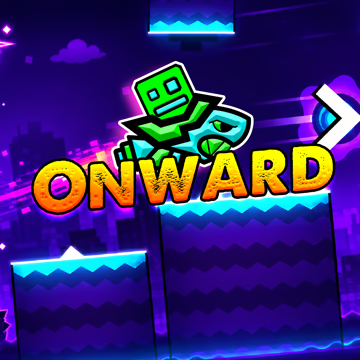
Geometry Dash Onward: The Story Behind a Challenging Rhythm Adventure
The idea behind Geometry Dash Onward came from something familiar in everyday life: moving forward often means adapting to changes you can't always predict. Whether you're working, studying, or pursuing personal goals, an approach that works in one situation may no longer be effective when circumstances change. This idea inspired the creation of a level that not only tests your reflexes but also encourages you to observe, learn, and adjust your strategy as you face each challenge.
With Geometry Dash Onward, the gameplay revolves around constant transitions. Instead of repeating the same familiar sequence from start to finish, you encounter different movement mechanics, from jumping over spikes to reversing gravity and controlling a flying ship through narrow spaces.
Every failure is part of the learning process. When you hit an obstacle, you get a chance to figure out whether you reacted too early, failed to jump far enough, or didn't adapt to a new mechanic in time. Progress comes from turning unsuccessful attempts into practical experience.
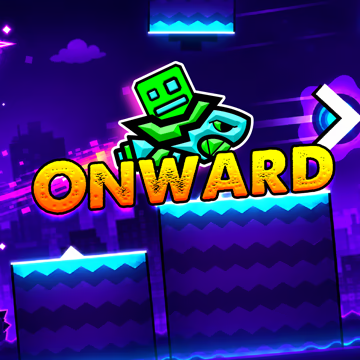
Figure 1. Play Geometry Dash Onward online
Building the Gameplay Flow of Geometry Dash Onward
Connecting Mechanics for a Smooth Gameplay Rhythm
When designing the gameplay for this level, the focus was on how each section connects to the next rather than treating every obstacle as a separate challenge. A well-paced level creates smooth transitions between moments that let you observe your surroundings and sections that demand quick reactions.
The journey begins with the familiar Cube form, where you learn to time your jumps over spikes and gaps. As the speed increases or your character changes size, seemingly simple actions require greater precision. Then, mechanics such as Ball, Robot, Ship, and UFO introduce different challenges involving gravity, altitude, and the timing of your actions.
The goal is to make every section feel like a meaningful part of the overall experience. Basic jumping sections help you find your rhythm, transformation portals introduce new ways to play, and obstacle-heavy areas test how well you apply what you've learned.
Balancing Difficulty, Reflexes, and Learning
An effective challenge doesn't have to make you fail repeatedly. What's more important is being able to understand your mistakes and figure out how to improve. That's why obstacle placement, reaction time, and the clarity of each mechanic are key considerations when evaluating gameplay design.
In Geometry Dash Onward, Ship sections require careful control of your altitude, while Cube and Robot sections emphasize precise jump timing. Ball sections challenge you to adapt to gravity reversals. Each mechanic presents a different problem, putting your skills to the test in multiple ways.
Creating the Visual Identity of Geometry Dash Onward
In a game that demands quick reactions, visuals need to do more than make an impression. They also need to help you read the situation. The game follows Geometry Dash's signature geometric style, using platforms, spikes, spinning saws, and transformation portals to create a clear environment where you can quickly identify important elements along the way.
Distinctive colors help separate different elements and create visual contrast between areas with varying obstacle density. Clear geometric shapes also help you recognize landing spots, gaps you need to cross, and objects you must avoid. As the speed increases, quick visual recognition becomes an essential part of the experience because there's little time to stop and analyze every detail.
Transformation portals act as visual cues for upcoming gameplay changes. They signal that your movement mechanics are about to change, giving you a chance to prepare your next action. Meanwhile, spikes and spinning saws present recognizable hazards that still require precise timing to overcome.
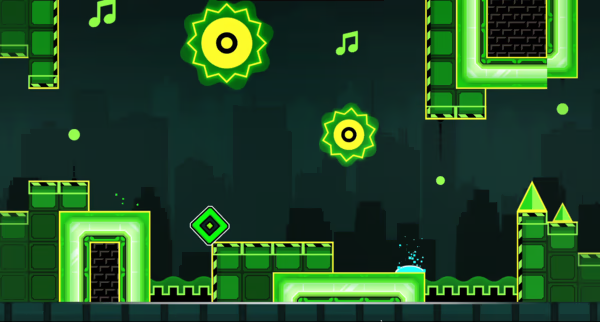
Figure 2. Creating the Visual Identity
How to Play Geometry Dash Onward
Main Objective
The goal in Geometry Dash Onward is to guide your character through every obstacle and reach the finish line without crashing. Along the way, you'll encounter sections that require precise jumps, gravity changes, altitude control, and quick adaptation to different movement mechanics.
Besides completing the level, you can also search for three coins scattered throughout the course. These collectibles offer an extra goal for anyone who wants to explore the level more thoroughly and test their control skills.
Controls
- On a computer: you can use the left mouse button to jump or trigger the appropriate action for your current character form.
- On mobile devices: tapping the screen provides a direct and convenient way to control your character.
Three Coins, One Goal: Exploring Every Challenge in Onward
The three coins give you another objective beyond simply completing the level. They encourage you to pay closer attention to the layout, explore hard-to-reach areas, and sharpen your control skills.
Collecting all three coins is another step toward mastering the level. Once you've completed the main route, you can focus on sections that require more careful planning. However, don't let these extra objectives distract you from learning the core mechanics first.
Geometry Dash Onward in Browser
Geometry Dash Onward offers a convenient experience for fans of browser-based rhythm games. With the web version available on geometrydashlite3d.com, you can jump straight into the game without going through a complicated installation process. This makes it easy to start a new run, whether you want to test your skills for a few minutes or spend more time improving your performance.
If you enjoy challenges that combine rhythm, speed, and skill, start your journey with Geometry Dash Onward and discover your limits with every attempt.